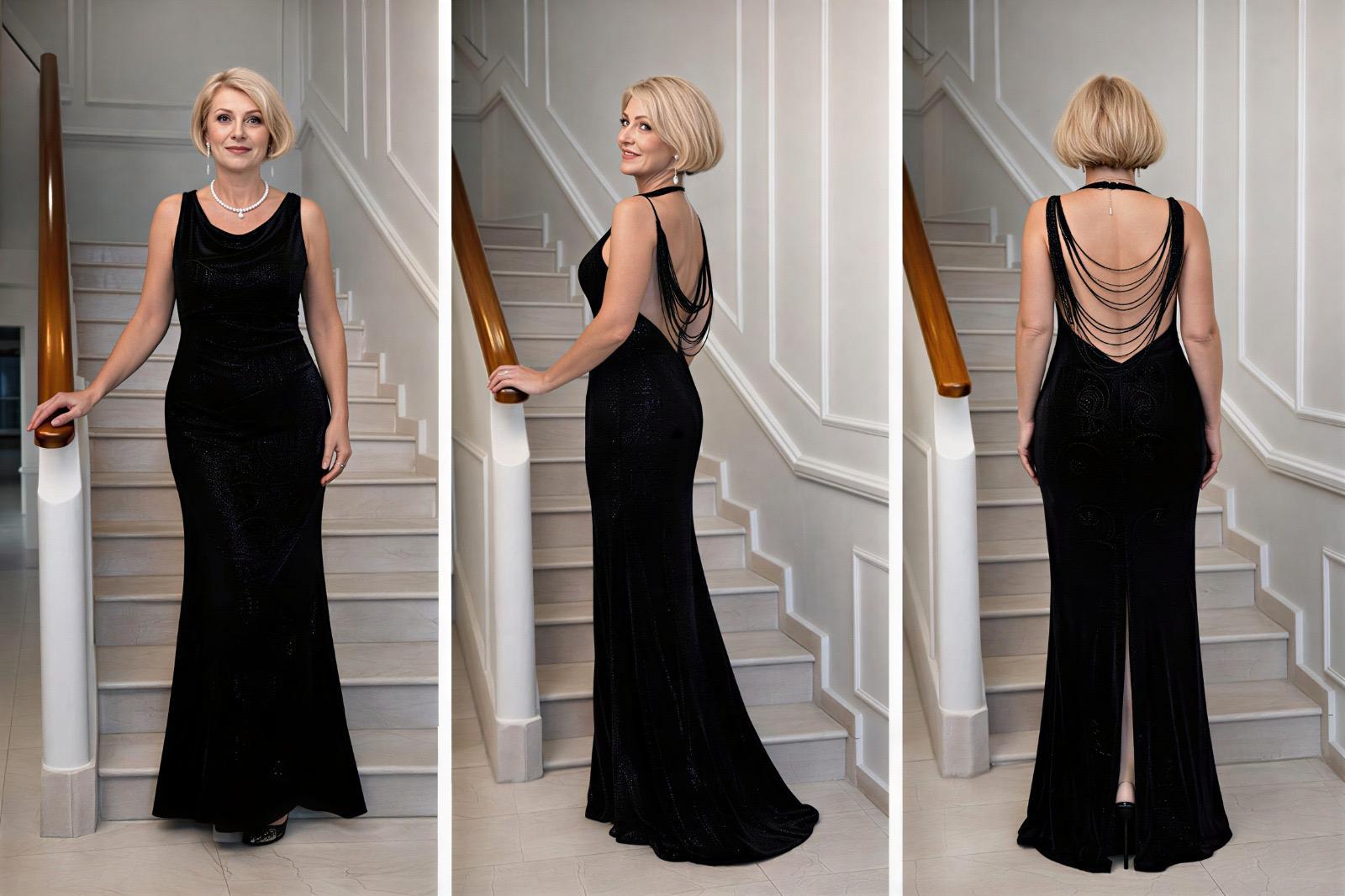
Black is not a colour so much as a discipline.
Any fabric can be dyed. Not every fabric behaves in black the way it needs to — with density, with depth, with the particular quality of absorbing light rather than reflecting it. When a black dress fails, it looks flat. When it works, it looks like a decision.
This sketch was made for a client who said two things in our first appointment. The first was that she did not want to look like she was trying. The second was that she was going to a gala in Monaco in February. Those two requirements are not in conflict. But resolving them takes some thought.
Structure Without Armour
The silhouette is column. Not sheath — there is a distinction. A sheath follows the body. A column proposes one. This dress does not cling; it descends with its own logic, skimming rather than gripping, with just enough ease through the hip to allow a full stride.
The shoulder is the architectural moment. A single structured seam runs from the left collarbone to just past the shoulder point, creating a slight forward pitch that makes the neckline asymmetric without announcing itself. The right side is a clean, bare line from shoulder to bust. The left carries a narrow band of fabric that crosses the chest and anchors at the opposite side seam — not a strap, not a drape, something with no convenient name.
It took four attempts in toile before it sat the way the sketch intended.
Fabric Notes
Silk mikado from Dormeuil, Milano — 140cm width, jet black. Mikado is an Italian-origin fabric, technically a type of satin, but heavier and with less surface sheen. It photographs as a deep matte. Under event lighting it develops a very slight lustre that appears only when the wearer moves.
The lining is silk crepe de chine in black, chosen specifically because it does not shift against the outer fabric. There is nothing more distracting than a lining that moves independently of the dress.
The hem is weighted with a 6mm chain sewn into the facing. This is an old couture technique, largely abandoned by most ateliers. It keeps the column perfectly perpendicular to the floor at all times and is invisible at the hem.
On the Sketch Itself
Evening gowns tolerate fewer errors than bridal gowns. A bridal dress has romance to fall back on — an imprecision can read as softness. An evening gown has nothing to hide behind. Every seam is deliberate or it is wrong.
This sketch went through six versions. The asymmetric shoulder was there from the beginning. The column silhouette was there from the beginning. What changed: the neckline depth, the hem length, the question of whether to split the back seam and allow a small vent for movement at the knee.
The vent was removed in the final version. It was the right choice. The dress moves by allowing the body to find its own way through the fabric. That is enough.