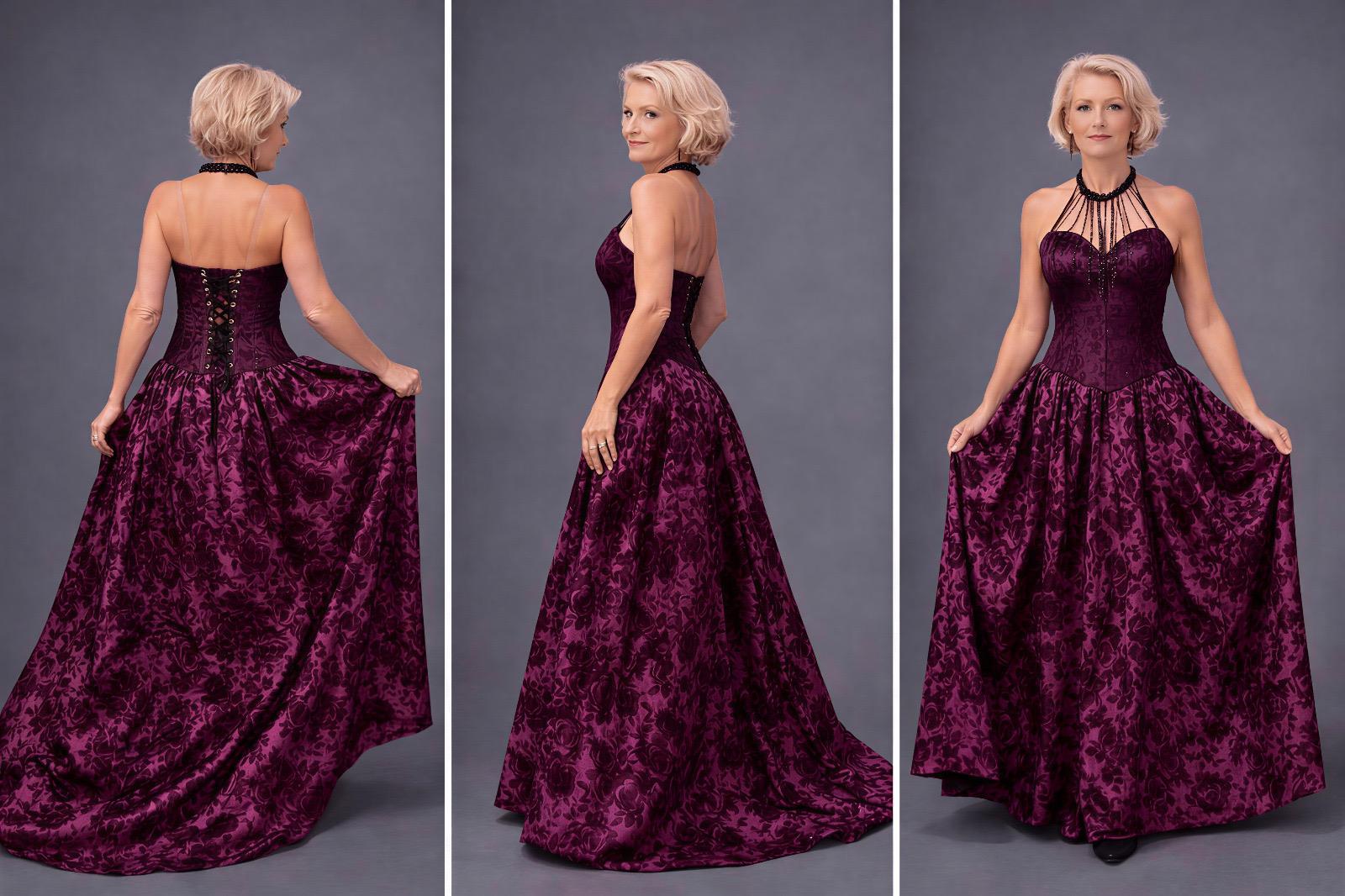
Drape is not decoration. It is engineering by another name.
When fabric is cut on the bias — at forty-five degrees to the grain — it acquires properties its warp and weft do not naturally possess. It stretches. It clings. It recovers. It responds to the heat of a body and begins, over hours, to memorise the shapes it is asked to hold. A bias-cut dress is not finished when it leaves the atelier. It finishes itself on the first wearing.
This sketch was an exercise in controlled drape: how much movement to allow, how much to restrain, and where the boundary between the two creates the silhouette’s character.
The Problem with Drape
Drape that is left entirely to gravity becomes formless. Drape that is entirely controlled becomes rigid. The skill is in deciding, at each point in the construction, which force should win.
In this study the bodice is fitted — cut from a woven silk charmeuse with enough structure to hold the shoulder and bust line without boning or internal support. The seaming through the bodice is minimal: a princess seam on each side, pressed open to lie completely flat. Below the natural waist, the construction changes its mind. The skirt is cut in six panels, each on a true bias, each allowed to hang freely from the waist seam. At the hip they begin to separate. At the knee they have developed into distinct, flowing sections. At the floor they pool.
The pooling is deliberate. An extra eight centimetres of length was added in the final toile, which seemed excessive on the stand. On a moving body, it disappears into the sweep.
A Note on Fit
Bias-cut dresses require more fittings than any other construction. The fabric continues to relax between appointments. What fits perfectly on a Wednesday may need adjustment by the following Monday. This is not a flaw in the process. It is the process.
Clients are sometimes surprised by this. They expect a dress to be fixed at the second fitting and finished at the third. A bias gown often requires four or five. The final fitting happens the day before the event, when the fabric has settled, the hem has been confirmed at the right shoes, and the dress has — in the most literal sense — learned its wearer.
That is what this sketch is really about. Not the panels, not the charmeuse, not the pooled hem. It is about a dress that does not exist until someone puts it on.